
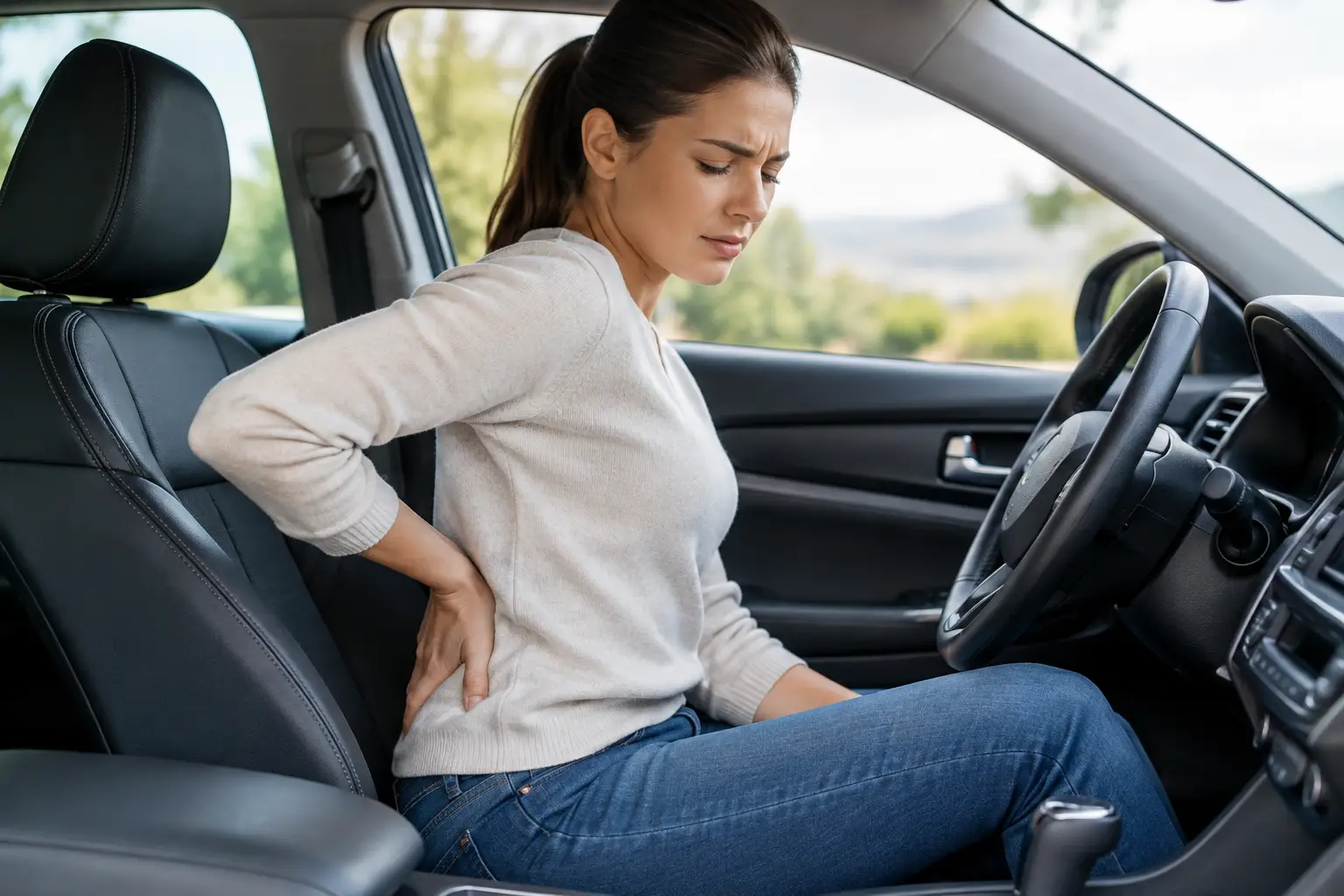
A drive across town should not leave you counting the seconds until you can get out of the car. Yet for many people, sitting behind the wheel brings a familiar ache from the low back into the buttock, thigh, calf, or foot. Knowing how to relieve driving sciatica starts with changing the positions and habits that irritate the nerve, not simply trying to tolerate the pain until you arrive.
Sciatica is a symptom, not a diagnosis by itself. It usually involves irritation or compression of nerve roots in the lower back, often from a disc problem, spinal narrowing, joint dysfunction, muscle tension, or inflammation after an injury. Long periods of driving can aggravate it because the hips stay bent, the low back is loaded in one position, and vibration from the road adds repeated stress.
Why Driving Can Flare Up Sciatica
The driver’s seat can put the pelvis in a rounded, slouched position, especially when the seat is reclined too far or positioned too far from the pedals. That posture may increase pressure through the low back and make already sensitive tissues less tolerant. Reaching for the steering wheel, twisting to check blind spots, and holding one foot in the same position can add to the problem.
Traffic makes it harder. Stop-and-go driving keeps the right leg active while the rest of the body stays relatively still. A long commute, rideshare shift, delivery route, or drive around Oahu can become a daily trigger when there is little opportunity to stand, walk, and reset.
Pain does not always mean more damage is occurring, but persistent or worsening symptoms deserve attention. The goal is to reduce irritation while restoring the movement and strength that help your back tolerate sitting again.
How to Relieve Driving Sciatica Before You Start the Car
A few minutes of preparation can make a meaningful difference. Start by setting up the seat so you can reach the pedals without sliding forward or locking your knee. Your hips should sit all the way back in the seat, with your knees roughly level with or slightly lower than your hips. If the front edge of the seat presses hard behind your knees, lower it or adjust its tilt if your vehicle allows.
Bring the seatback more upright than you may think you need. A modest recline is comfortable, but a heavily reclined seat encourages slumping and makes you reach for the wheel. Move the steering wheel toward you when possible so your shoulders can stay relaxed rather than rounded forward.
Support the natural curve of your lower back. Some people do well with a small lumbar roll or a rolled hand towel placed at belt level. The support should feel gentle, not like it is forcing an exaggerated arch. If it increases leg symptoms, remove it and try a thinner support or a different position.
Before a longer drive, take a short walk instead of going directly from a chair into the car. A minute or two of easy movement warms the hips and spine. If one direction of motion reliably reduces your symptoms, a clinician may recommend a specific exercise. Avoid copying stretches that cause sharp pain, tingling, or symptoms traveling farther down the leg.
Avoid the Wallet-in-the-Back-Pocket Habit
Sitting on a thick wallet, phone, or set of keys tilts the pelvis and can irritate the muscles and nerves around the hip. Empty your back pockets before driving. It is a small change, but it removes a common source of uneven pressure.
Change Position Before Pain Builds
Even a well-adjusted seat cannot make the body comfortable in one position indefinitely. On longer drives, plan a brief stop every 30 to 60 minutes when practical. Step out, stand tall, and walk for two or three minutes. You do not need an intense stretch routine at a gas station. Gentle movement is often more useful than forcing a deep stretch into a painful area.
If you cannot stop because you are in traffic, use safe, subtle adjustments. Relax your grip on the wheel, let your shoulders drop, and check whether you have shifted onto one hip. At a complete stop, gently reposition your pelvis against the back of the seat. Do not perform distracting exercises while the vehicle is moving.
For people whose symptoms are worse on the right side, repeated pedal use can be a factor. Cruise control may reduce that repetitive demand on open roads when it is safe and legal to use. It is not appropriate in heavy traffic, rain, or conditions that require frequent speed changes.
Use Heat, Cold, and Medication Carefully
Heat can relax guarded muscles around the low back and hip before a drive or after you arrive. A warm shower or heating pad used according to its instructions may help stiffness, but do not use a heating device in a way that could burn the skin or distract you while driving.
Cold may feel better after a flare-up, particularly if the area feels inflamed or sore. Either approach should be brief and comfortable. If you have reduced sensation, circulation problems, or a condition that affects your ability to feel temperature, ask a healthcare professional before using heat or ice.
Over-the-counter anti-inflammatory medicine or pain relievers can be appropriate for some people, but they are not right for everyone. Medical conditions, blood thinners, ulcers, kidney disease, pregnancy, and other medications can change what is safe. More importantly, medication may quiet symptoms without addressing why driving keeps provoking them. Never take anything that makes you drowsy before getting behind the wheel.
Build More Tolerance Between Drives
Driving sciatica often improves when treatment focuses on more than the car seat. A thorough evaluation can identify whether your symptoms appear to be coming primarily from the lower back, hip, surrounding muscles, or a combination of factors. The right approach depends on the pattern of pain, neurological findings, recent injuries, work demands, and how long symptoms have been present.
For some patients, hands-on chiropractic care and rehabilitative exercises help improve spinal and hip movement while reducing muscle guarding. Massage therapy may help when tight gluteal, hip, or low-back muscles are contributing to discomfort. Other patients may be candidates for therapies such as spinal decompression, laser therapy, or shockwave therapy, depending on the source of pain and clinical evaluation.
The trade-off is that passive treatments can provide needed relief, but lasting improvement usually also requires better daily movement habits. A plan should include realistic exercises, guidance on sitting and lifting, and a way to progress back to the driving, work, and activity demands that matter to you. If a car accident or work injury started your symptoms, seeking care promptly also creates a clearer record of your condition and helps prevent a temporary strain from becoming a long-term problem.
When Sciatica Needs Urgent Medical Attention
Most episodes of sciatica can be assessed in a non-emergency clinical setting, but certain symptoms should not wait. Seek urgent medical care for new loss of bowel or bladder control, numbness in the groin or saddle area, significant or rapidly worsening leg weakness, fever with severe back pain, or pain after a major fall or collision.
Also schedule an evaluation soon if pain continues to spread down the leg, numbness is increasing, sleep is consistently disrupted, or driving and work are becoming difficult despite seat changes and rest. These signs do not automatically mean surgery is needed. They do mean the problem deserves a careful examination rather than more time spent pushing through it.
At Honolulu Pain Relief Center, patients with sciatica receive an individualized assessment and non-invasive treatment plan designed around their symptoms, mobility, and daily demands. The right care should leave you with a clear next step: less pain in the driver’s seat, more confidence getting where you need to go, and a plan that supports your life outside the car.