
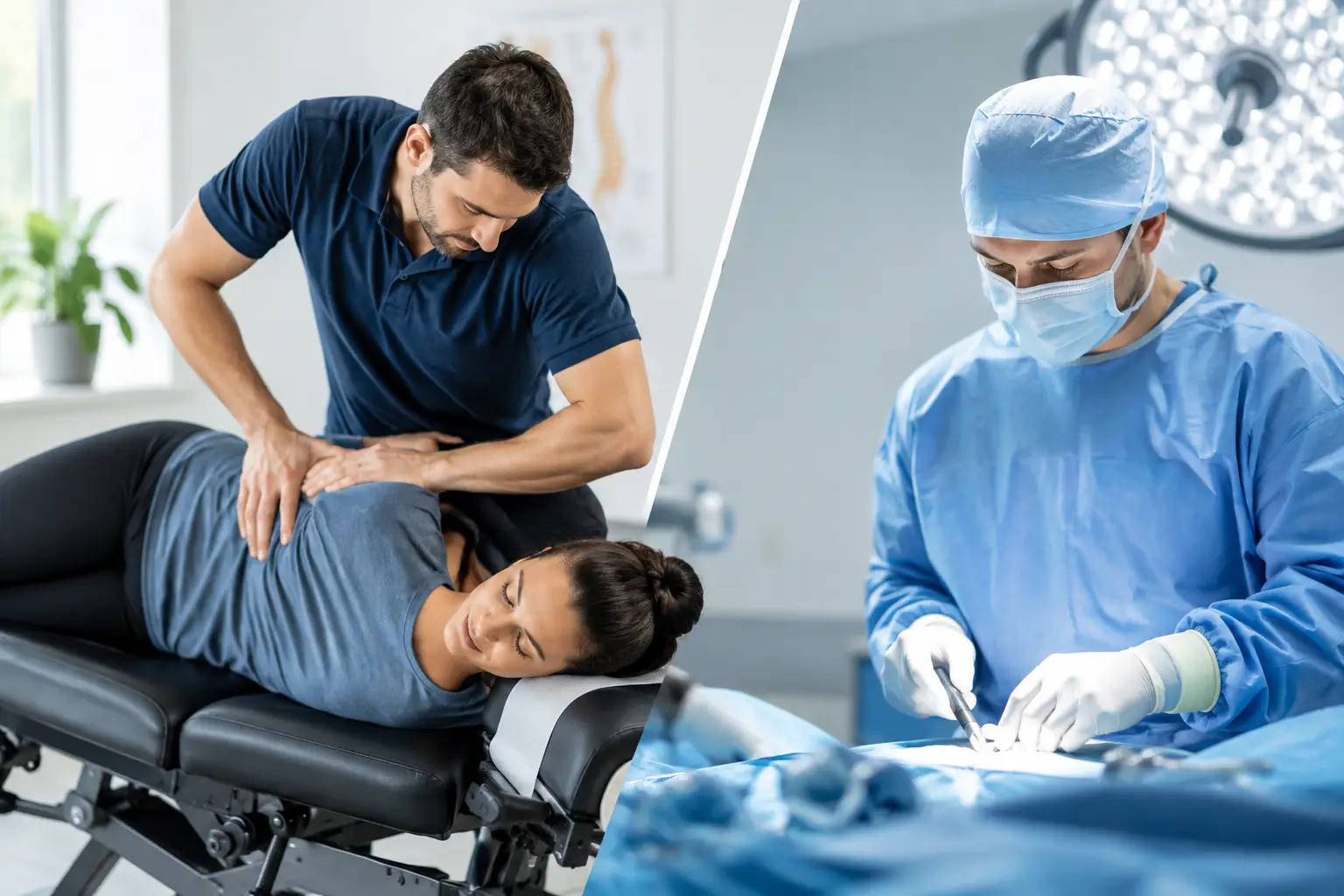
A painful back, stiff neck, or shooting leg pain can make every shift, commute, and night of sleep feel harder than it should. When symptoms persist, the question of chiropractic versus surgery often comes up quickly. The right answer is not the same for every patient. It depends on your diagnosis, the severity of nerve involvement, your medical history, and how your body responds to conservative treatment.
For many musculoskeletal conditions, non-invasive care is a reasonable first step. For others, surgery may be necessary to protect nerve function or address a structural problem that will not improve without it. The goal is not to delay appropriate treatment. It is to choose the least invasive option that can safely help you move better and get back to daily life.
Chiropractic Versus Surgery: Start With the Diagnosis
Back and neck pain are symptoms, not diagnoses. A strained muscle after lifting, pain following a car accident, spinal arthritis, a disc injury, and spinal stenosis can all feel similar at first. Yet they may require very different care plans.
A thorough evaluation should consider where your pain begins, whether it travels into an arm or leg, what movements aggravate it, how long it has lasted, and whether you have numbness, tingling, or weakness. Your provider may also review imaging and coordinate with your primary care doctor, orthopedic specialist, neurologist, or surgeon when appropriate.
This step matters because an MRI finding alone does not always determine treatment. Many adults have disc bulges or degenerative changes on imaging without pain. A good treatment decision matches the scan with your physical exam, symptoms, function, and neurological findings.
When Conservative Chiropractic Care May Make Sense
Chiropractic care is designed to address joint restriction, muscle tension, movement patterns, and mechanical stress that can contribute to pain. Care may include gentle spinal adjustments, mobilization, soft-tissue work, therapeutic exercise, stretching, and guidance on activity modification. At Honolulu Pain Relief Center, treatment may also be combined with massage therapy, spinal decompression, laser therapy, shockwave therapy, and rehabilitation when clinically appropriate.
For many people, this kind of hands-on, non-invasive care is worth considering before surgery for uncomplicated back or neck pain. It can be especially useful when symptoms are related to poor movement mechanics, repetitive work demands, muscle guarding after an accident, or joint stiffness that limits normal motion.
Conservative care is not about telling patients to simply live with pain. A focused plan should have measurable goals: less pain when standing, easier rotation while driving, fewer headaches, improved sleep, longer walking tolerance, or a safer return to work and exercise. Progress should be reviewed regularly. If a treatment plan is not improving function, it should be adjusted rather than continued indefinitely without a clear reason.
Conditions That Often Begin With Non-Invasive Care
Many cases of acute low back pain improve over time with appropriate conservative management. Neck pain associated with posture, muscle strain, or minor joint dysfunction may also respond well. Some patients with sciatica caused by disc irritation can improve with a combination of movement-based care, decompression, and rehabilitation, particularly when there is no progressive weakness.
After an auto accident, symptoms can also take days to fully appear. Neck stiffness, headaches, upper-back pain, and low-back pain may result from soft-tissue injury and altered movement patterns. Early evaluation can help document the injury and establish a treatment plan that supports recovery while monitoring for signs that require medical referral.
What Surgery Can Do That Chiropractic Care Cannot
Surgery has an essential role in spine care. It may remove pressure from a nerve, stabilize an unstable spinal segment, repair certain fractures, or address severe narrowing around the spinal cord or nerve roots. These are structural interventions, and chiropractic care is not a replacement when an operation is medically necessary.
For example, a patient with a large disc herniation and worsening leg weakness may need a surgical consultation promptly. Someone with severe spinal stenosis whose walking ability is steadily declining may also be a candidate for decompression surgery. In these situations, the potential benefit of surgery may outweigh the risks of waiting.
Surgery can bring meaningful relief, but it is still major medical treatment. Recovery may involve anesthesia, post-operative pain, time away from work, physical therapy, medication, and restrictions on lifting or movement. Results vary based on the procedure, condition being treated, overall health, and whether the source of pain has been correctly identified.
It is also reasonable to ask a surgeon what the procedure is expected to improve. Surgery tends to be more predictable for specific nerve-related symptoms, such as pain traveling down the leg from a confirmed nerve compression, than for generalized back pain without a clear pain generator.
Red Flags That Need Immediate Medical Attention
Do not wait for a chiropractic appointment if you have symptoms that could signal a serious medical emergency. Seek urgent medical evaluation for new loss of bowel or bladder control, numbness in the groin or inner thigh area, rapidly worsening weakness in an arm or leg, severe pain after significant trauma, fever with severe spinal pain, or unexplained weight loss with persistent pain.
These symptoms are uncommon, but they require prompt assessment. A responsible chiropractor will screen for these concerns and refer when the safest next step is medical or surgical care.
The Real Trade-Offs to Discuss
The choice is rarely as simple as “natural care” versus “serious care.” Both conservative treatment and surgery are legitimate tools. The question is which tool fits your condition now.
Chiropractic care is generally lower risk and does not involve an incision, hospitalization, or surgical recovery. It may help reduce pain, restore mobility, and support rehabilitation, but it usually requires a series of visits and active participation between appointments. Results can be gradual, especially when pain has been present for months or years.
Surgery may offer faster relief in selected cases of clear nerve compression or instability, but it carries surgical risks and does not guarantee that all pain will disappear. A fusion, for instance, may reduce motion at one spinal level and can change how surrounding segments handle stress over time. These trade-offs deserve a straightforward conversation, not pressure in either direction.
A second opinion can be valuable when surgery has been recommended for non-emergency symptoms. It can confirm the diagnosis, clarify whether conservative care has been fully attempted, and help you understand the expected outcome if you proceed.
How to Make a Confident Next Decision
Start by asking what is causing your symptoms and what findings support that explanation. Ask whether there is evidence of nerve damage, instability, fracture, infection, or another concern that changes the urgency of care. Then ask what improvement is realistic with conservative treatment, how long that trial should last, and what would indicate a need for referral.
Your daily demands matter, too. A hotel worker who lifts and bends throughout a shift, a nurse on their feet all day, a driver dealing with long hours of sitting, and a surfer returning after an injury may all need plans built around different movement requirements. Pain relief matters, but so does building enough strength, mobility, and confidence to return to the activities that matter to you.
If you have been told surgery is your only option, it is fair to ask whether the recommendation is urgent and whether a trial of non-invasive care is medically appropriate. If you have tried conservative treatment without meaningful improvement, it is equally fair to request further testing or a specialist evaluation. The best path is the one that protects your health while giving you a realistic opportunity to recover with the right level of care.